
Class EA Process
The Ontario Ministry of Transportation (MTO) has retained WSP Canada Inc. to undertake this project which is following the Class Environmental Assessment (EA) for Provincial Transportation Facilities and Municipal Expressways (2024) process for Group ‘A’ projects.
(https://www.ontario.ca/page/class-ea-provincial-transportation-facilities)
Throughout the project, input will be sought from the public, stakeholders, and Indigenous communities. In addition to consultation activities, a comprehensive program of field investigations will be undertaken to collect information and data that will support the evaluation and refinement of design alternatives.
These investigations may include studies related to ecology, geotechnical conditions, archaeology, and other technical disciplines, as required.
As part of the study, one public information centre is anticipated to be held in spring 2026. Upon completion of the preliminary design study, a transportation environmental study report (TESR) will be prepared to document the preliminary design plans and the proposed environmental mitigation measures. The TESR will be made available for a 30-day comment period.
A summary of the study schedule and consultation process is shown below.
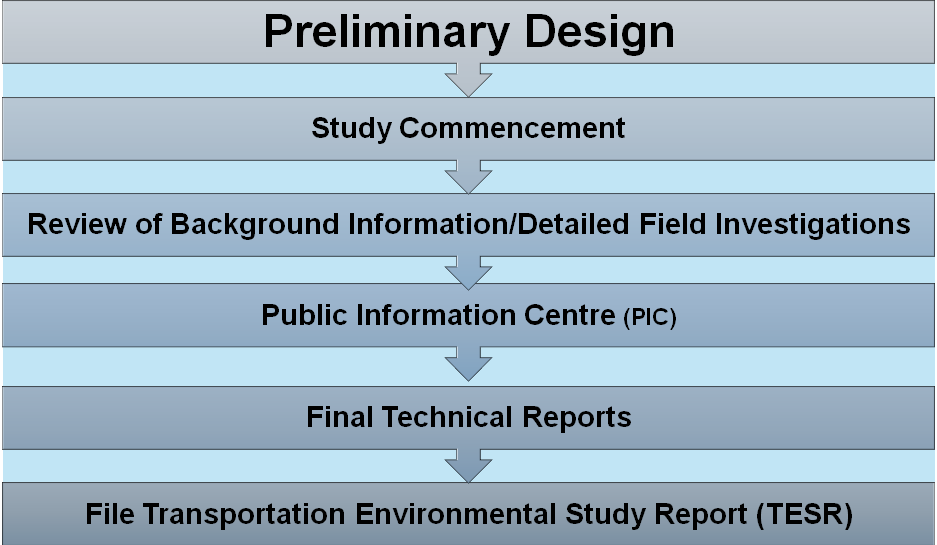
Detailed information regarding the environmental assessment process and the Ontario Environmental Assessment Act is available here.
Once the preliminary design is complete, the project will proceed to the detail design stage; MTO will complete the following to document the detailed design:
- Fulfill obligations and obtain permits / approvals required under other environmental legislation (e.g., Fisheries Act, Endangered Species Act, Heritage Act);
- Follow the directives, policy and practices outlined in the MTO Environmental Standards and Practices;
- Consult with Indigenous communities and fullfill obligations towards constitutionally-protected Aboriginal and treaty rights;
- Follow through with Preliminary Design commitments as documented in the TESR;
- Ensure that mitigation measures are refined and developed for implementation during construction through contract drawings, specifications, and other Contractor requirements; and
- Determine whether any design changes during detail design are significant and require a TESR Addendum.
Following the completion of the detailed design, MTO will advance the design to a construction level of detail and prepare the contact drawings, tendering documents, specifications, schedules, and cost estimates.
